AI Foundations
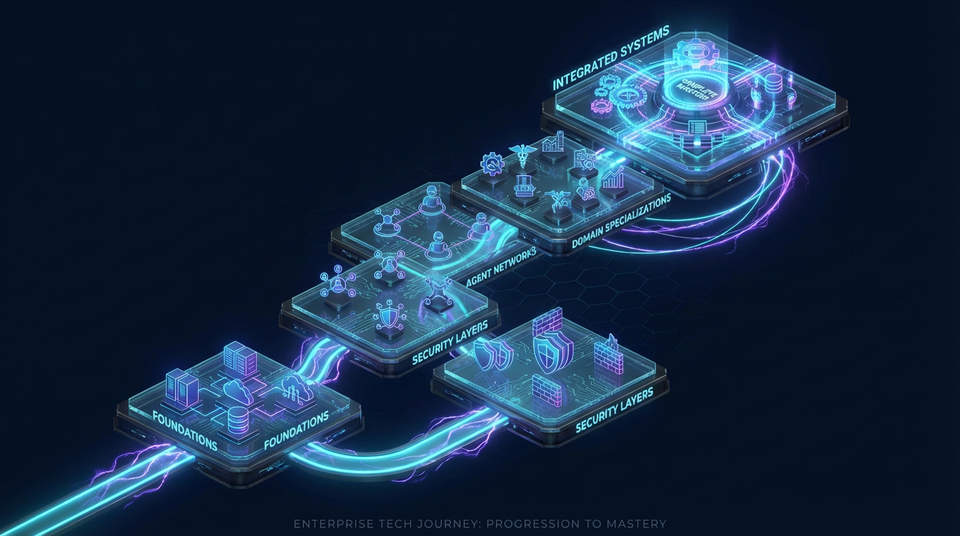
A structured path from full-stack fundamentals to production-ready agentic AI applications. Five levels. One architecture. No shortcuts. ## Introduction Most AI projects fail not because the models are weak, but because the systems around them are fragile. AI Foundations is a progressive curriculum that builds your expertise from production infrastructure through authentication, agent development, domain specialization, and finally to complete applications. Each level builds on the previous, ensuring you never add complexity to chaos. This isn't a tutorial series about prompts or model comparisons. It's an architecture-first approach to building AI systems that actually work at scale. — ## The Five Levels ### Level 0: Full-Stack Foundations **The infrastructure every AI system needs** Before you can build AI agents, you need infrastructure that can support them. Level 0 establishes production-ready patterns for FastAPI, PostgreSQL, React, and TypeScript—plus the Five Guardrails (tests, linting, types, logging, architecture) that let AI-assisted development remain safe and controlled. [Explore Level 0 →](/level-0/) — ### Level 0.5: Authentication **The security boundary before autonomy** Authentication isn't an afterthought—it's the hard boundary that must exist before any agentic capabilities can be safely introduced. Level 0.5 implements JWT authentication, role-based access control, and session handling that prepares your system for agents that need to operate within defined permissions. [Explore Level 0.5 →](/level-0-5/) — ### Level 1: AI Agent Core **The fundamentals of agentic systems** With infrastructure and identity in place, Level 1 introduces the core components of AI agents: LLM clients, tool frameworks, agent orchestration, and context management. This is where systems start thinking—within the guardrails established in previous levels. [Explore Level 1 →](/level-1/) — ### Level 2: Domain Patterns **Specialized applications of agent capabilities** Level 2 applies agent fundamentals to specific business domains. Investment analysis, operations automation, customer service, and content creation each require domain-specific patterns, tools, and knowledge bases—but share common architectural principles. [Explore Level 2 →](/level-2/) — ### Level 3: Applications **Complete production systems** Level 3 brings everything together into real-world agentic AI applications. These are complete systems you can study, adapt, and deploy—demonstrating how all the previous levels combine into solutions that actually work. [Explore Level 3 →](/level-3/) — ## Why This Approach ### The Problem Most AI education jumps straight to agents and prompts without addressing the infrastructure those agents will operate within. The result: fragile demos that fail in production. ### The Solution AI Foundations takes the opposite approach. We build infrastructure first, add security second, and only then introduce agentic capabilities. Each level is production-ready before moving to the next. ### The Outcome Systems that don't fall apart. AI that operates within defined boundaries. Applications that can evolve without breaking. Engineers who understand the full stack. — ## Video Series The AI Foundations curriculum is available as a comprehensive video series covering Levels 0 and 0.5 in detail. [Watch the AI Foundations Playlist on YouTube →](https://www.youtube.com/playlist?list=PLlRV2byV2bQF8vTVyezNmvdOvJ8fWJZJZ) — ## Related Resources - [The Five Guardrails →](/five-guardrails/) - [Frontend Patterns →](/frontend-patterns/) - [Backend Patterns →](/backend-patterns/) - [Nine Skills Framework →](/nine-skills/)